
The tax treatment of a Roth IRA withdrawal depends on what the withdrawal is considered to include. An IRA owner cannot choose to withdraw amounts from a particular Roth IRA or designate the withdrawal as coming from a particular conversion.
Instead, all of an individual’s noninherited Roth IRAs are aggregated, and withdrawals are treated as coming out in this order:
- Regular Roth IRA contributions
- Conversion and rollover contributions, beginning with the earliest conversion year
- Earnings
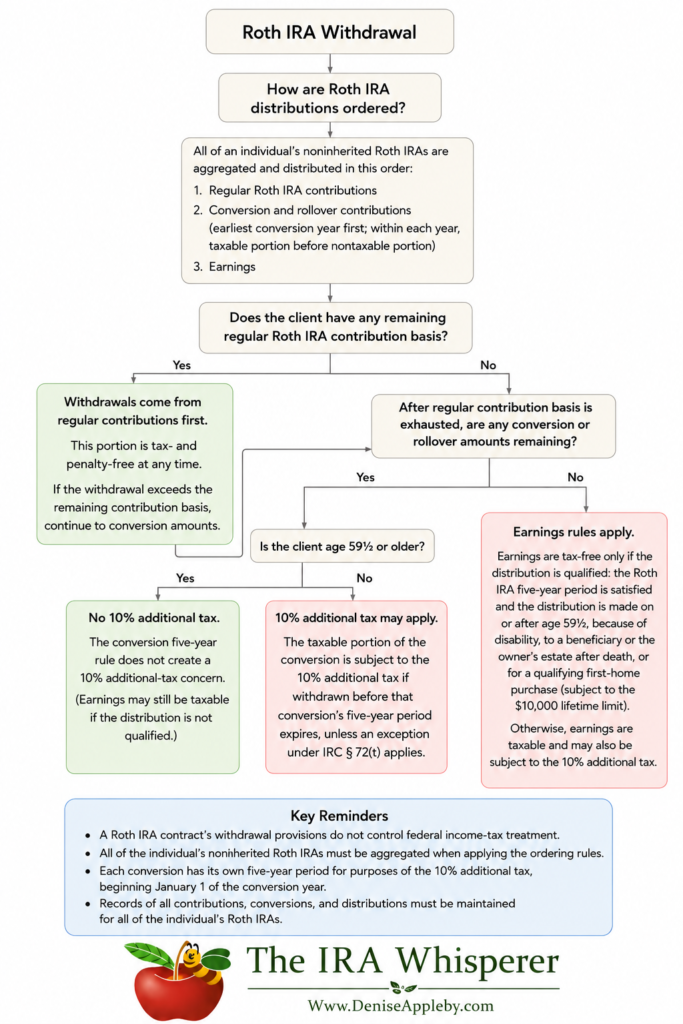
Regular Roth IRA contributions may be withdrawn tax- and penalty-free at any time.
Conversion amounts are not taxed again when withdrawn. However, if the IRA owner is under age 59½, the portion of a conversion that was taxable when converted may be subject to the 10% additional tax if withdrawn before that conversion’s five-year period expires, unless an exception applies. Each conversion has its own five-year period for this purpose, beginning January 1 of the conversion year.
Once the IRA owner reaches age 59½, the conversion five-year rule no longer creates a 10% additional-tax concern. However, earnings may still be taxable if the distribution is not qualified.
The withdrawal provisions of an annuity or other Roth IRA investment do not determine the federal income-tax treatment. Accurate records of all Roth IRA contributions, conversions, and prior distributions are essential for applying the rules correctly.